
When you imagine a professional radio station or a high-end podcast studio, odds are you picture a bulky, matte-finished microphone with distinct vertical slots running down its body. That look belongs to Electro-Voice, and specifically, to their legendary broadcast lineup.
The Electro-Voice RE20 has been an industry gold standard since 1968. But its younger sibling, the RE320, arrived at a significantly lower price point, promising similar performance with a few modern twists.
If you are upgrading your podcast setup, is it worth dropping the extra cash on the classic RE20, or does the RE320 give you everything you need for less? Let’s break down the data, the tone, and the technical realities.
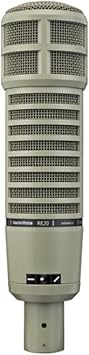
|

|
|
$399.00
|
$265.00
|
The Core Specs
Before diving into how they sound, let’s look at how they stack up on paper:
| Feature | Electro-Voice RE20 | Electro-Voice RE320 |
| Microphone Type | Large-diaphragm Dynamic | Large-diaphragm Dynamic |
| Polar Pattern | Cardioid | Cardioid |
| Frequency Response | $45\text{ Hz} – 18\text{ kHz}$ | $45\text{ Hz} – 18\text{ kHz}$ |
| Sensitivity | $-56.5\text{ dBV/Pa}$ | $-52\text{ dBV/Pa}$ (Hotter Output) |
| Proximity Control | Variable-D Technology | Variable-D Technology |
| On-Mic Switches | High-Pass Filter (Low-Cut) | Dual-Voice (Flat vs. Kick Drum/Scoop) |
| Street Price | ~$449 | ~$299 |
The Big Shared Secret: Variable-D Technology
Both microphones feature Electro-Voice’s patented Variable-D (Variable Distance) technology.
On standard directional microphones, a phenomenon called the proximity effect occurs: the closer you get to the grille, the more boomy and muddy your voice sounds. If a podcaster moves around or leans into the mic, their audio quality changes drastically.
Variable-D fixes this using physical acoustic vents along the microphone body. It mechanically delays rear-entry sound waves, neutralizing the bass buildup.
The Podcaster Benefit: With either mic, you can “eat the microphone” (get right up against the grille) to control room noise without your voice turning into a muddy, bass-heavy mess. Your audio stays consistent even if you lean back or shift in your chair.
Where They Differ (And Why It Matters)
While they look nearly identical and share the same heavy-duty steel build quality, they are vastly different beasts under the hood.
1. The Sonic Signature (Flat vs. Formatted)
- The RE20 is famous for being incredibly flat and neutral. It doesn’t artificially sweeten your voice; it captures exactly what is put in front of it. It features subtle dips in the mid-range and a very gentle high-end roll-off that tames harsh “S” sounds (sibilance). It delivers that classic, smooth, authoritative “late-night radio host” warmth.
- The RE320 uses a different neodymium magnet structure, making it brighter and punchier. It features a sharp $5\text{ dB}$ presence boost between $3.5\text{ kHz}$ and $10\text{ kHz}$. This adds modern clarity and “air” to your voice, making it pop through a mix without needing heavy equalization (EQ) in post-production.
2. Gain and Output Power
Dynamic broadcast microphones are notoriously quiet, but the RE320 has a distinct advantage here. Because of its modern magnet, its output is roughly $4.5\text{ dB}$ hotter than the RE20.
- RE20: Requires a massive amount of clean gain (around $55\text{ dB}-60\text{ dB}$). If you plug it into a budget audio interface, you will likely need an inline preamp like a Cloudlifter or FetHead to avoid introducing background hiss.
- RE320: Runs noticeably hotter. You can comfortably plug this directly into standard audio interfaces (like a Focusrite Scarlett or Volt) without needing an extra signal booster.
3. On-Board Switches
- The RE20 features a simple low-cut switch to roll off low-end rumble from air conditioners or desk vibrations.
- The RE320 features a Dual-Voice switch. In standard mode, it provides a bright vocal profile. Flip it to the “Kick Drum” mode, and it mechanically scoops out muddy low-mids ($350\text{ Hz}$) while boosting the low-end thud and high-end attack—making it a highly versatile tool if you also record musical instruments.
Which One Should You Buy?
Choose the Electro-Voice RE20 if:
- You want a true broadcast classic: You prefer a warm, smooth, forgiving, and uncolored vocal profile.
- You have the hardware: You already own a high-quality preamp or an audio interface with plenty of clean gain.
- You love tweaking in post: The flat response offers a perfect “blank canvas” for customized digital EQ and compression.
Choose the Electro-Voice RE320 if:
- You are on a budget: You want $90\%$ of the RE20’s build quality and proximity control while saving $150$.
- You want “ready-to-go” audio: You prefer a modern, crisp voice that cuts through background music instantly without extensive editing.
- Your interface is basic: You want to avoid spending an extra $100$ on an inline preamp booster.